Linarite
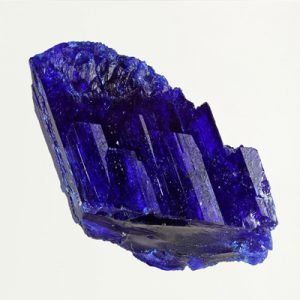
Linarite is a secondary mineral in the oxidized zones of lead-copper deposits. It is a fairly rare mineral and an extremely rare gem. The color of Linarite is a magnificent and intense blue and can be confused with Azurite. Linarite which comes in Sulfate minerals category, its chemical compound name is copper lead sulfate hydroxide with formulae PbCu[(OH)2|SO4]. The Hardness (Mohs) of this stone is (Linarite) 2.5, and then its fracture is Conchoidal.
Crystals are usually very, very small; typically found as crusts of tiny crystals on a host rock. Crystals are rarely large enough for faceting but even then clean areas of these crystals are usually very small.The Refractive Index of this stone is 1.809 – 1.859 Biaxial ( – ) . Gems are very difficult to cut due to the softness and perfect cleavage of the mineral. Linarite is also very collectible as a mineral specimen. Linarite is available from many locations but fine crystals mainly come from the Red Gill and other mines, Caldbeck Fells, Cumbria, England; Tsumeb, Namibia; Mammoth-St. Anthony mine, Tiger, Pinal County, Arizona, USA.
| Category: | Sulfate minerals |
| Formula: | PbCu[(OH)2|SO4] |
| copper lead sulfate hydroxide | |
| Crystallography: | Monoclinic – Prismatic |
| Crystal Habit: | Crystals are elongated along [010], typically tabular on [101] or [001], with about another 40 forms known, to 8 cm; in crusts and aggregates. |
| Twinning: | On [100], common; also on [001] |
| Cleavage: | [100] Perfect, [001] Distinct |
| Fracture: | Conchoidal |
| Tenacity: | Brittle |
| Hardness (Mohs): | 2.5 |
| Density: | 5.3 – 5.5 (g/cm3) |
| Luminescence: | None |
| Radioactivity: | Not Radioactive |
| Other: | Observed to alter to Antlerite and to Cerussite with Malachite. |
| Color: | Bright to dark Azure Blue, Sky Blue |
| Transparency: | Transparent to Translucent |
| Luster: | Vitreous to Sub-Adamantine |
| Refractive Index: | 1.809 – 1.859 Biaxial ( – ) |
| Birefringence: | 0.050 |
| Dispersion: | Strong; r < v |
| Pleochroism: | Visible; X = pale blue; Y = blue; Z = Prussian blue |