Magnesite
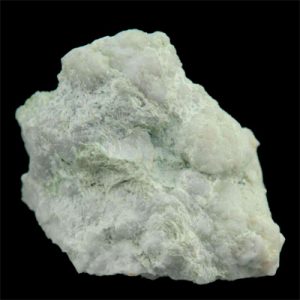
Magnesite with the chemical formula MgCo3 and its chemical name is Magnesium Carbonate. Magnesite occurs as veins in and a modification product of ultramafic rocks, serpentinite as well as other magnesium rock that is rich both in contact and regional metamorphic terrains. These magnesites often are cryptocrystalline and contain silica by means of chert or opal. The Specific gravity of this magnesite is 2.98 – 3.02 (g/cm3). Magnesite is also present within the regolith above ultramafic rocks as a carbonate that is secondary soil and subsoil, where it really is deposited because of dissolution of magnesium-bearing minerals by C02 within groundwaters
Magnesite is an extremely rare gem that is a member of the Calcite mineral group that includes Calcite, Siderite, Rhodochrosite, Smithsonite, Spherocobaltite, and Gaspeite. Facetable crystals are very rare and faceting is difficult due to its perfect rhombohedral cleavage. Magnesite gems are beautiful with huge birefringence and strong dispersion. Most gems are colorless but may also be yellowish, pale green or faintly pink. The current main source of facet grade crystals is Brumado, Bahia, Brazil.
| Category: |
Carbonate mineral |
| Formula | MgCO3 |
| magnesium carbonate | |
| Crystallography: | Trigonal – Hexagonal – Scalenohedral |
| Crystal Habit: | Uncommon as crystals. Crystals usually rhombohedral to 30 cm; rarely prismatic, tabular or scalenohedral. Typically massive, coarse- to fine-granular, very compact and porcelainous; earthy to rather chalky; lamellar; coarsely fibrous. |
| Twinning: | Unproven |
| Cleavage: | [1011] Perfect, [1011] Perfect, [1011] Perfect |
| Fracture: | Conchoidal |
| Tenacity: | Brittle |
| Moh’s Hardness: | 3.5 – 4.5 |
| Density: | 2.98 – 3.02 (g/cm3) |
| Luminescence: | May exhibit pale green to pale blue fluorescence and phosphorescence under UV; maybe Triboluminescent |
| Radioactivity: | Not Radioactive |
| Other: | Slightly soluble in water with the solubility increases with the presence of NaCl, Na2SO4, or CO2. |
| Color: | Colorless, white, pale yellow, pale brown, faintly pink, lilac-rose |
| Transparency: | Transparent to nearly opaque |
| Luster: | Vitreous |
| Refractive Index: | 3.0 – 3.2 |
| Birefringence: | 0.191 |